Secure Controls Framework
Download The SCF

Implementation Cycle

Plan-Do-Check-Act (PDCA)

SCF CORE Fundamentals is designed to operate within a continuous PDCA improvement cycle, not as a one-time compliance exercise.

Phase 1

PLAN

Identify applicable controls. Assess current state vs CORE Fundamentals baseline. Define remediation priorities and resource requirements. Establish risk appetite and MCR obligations.

Phase 2

DO

Implement controls across all 20 domains. Document policies, standards, and procedures. Deploy technical controls. Train personnel. Engage third-party assessor if pursuing SCR-CAP.

Phase 3

CHECK

Monitor control effectiveness. Conduct internal assessments against CORE Fundamentals criteria. Review Evidence Request List (ERL) satisfaction. Validate against MCR obligations.

Phase 4

ACT

Remediate gaps identified in the Check phase. Update policies and standards. Elevate from CORE Fundamentals toward higher-maturity control sets (ESP Level 1, 2, 3) as organizational capacity grows.

Creative Commons. No Cost

Download SCF CORE Fundamentals

All 68 controls, assessment guides, MCR/DSR classifications, ERL references, and TPRM questionnaire templates. Available in Excel (.xlsx) and CSV formats with NIST OSCAL JSON export.

Go To The SCF Download PageExplore Additional SCF Content

Licensed under Creative Commons. Volunteer-driven by the SCF Council. No registration required.

SCF CORE: Cybersecurity Oversight, Resilience & Enablement

Tailored control sets for specific organization types and risk profiles, purpose-built by the SCF Council for real-world operational realities.

About SCF CORE

Purpose-Built Control Sets for Every Organization

The SCF Council created the CORE initiative to address a critical gap. While the SCF catalog provides comprehensive coverage, many organizations, especially small and mid-sized businesses, need a focused, actionable starting point to tailor controls for their specific needs

The CORE initiative defines 7 tailored control sets, each calibrated to specific organization types, sizes, and risk profiles. These are not arbitrary subsets. Each CORE set is derived from the broader Common Controls Framework® (e.g., SCF control set).

The SCF was notably recognized in Texas Senate Bill 2610, which named the SCF as meeting cybersecurity framework adequacy for purposes of providing legal protection to businesses implementing reasonable cybersecurity practices. This was the first time a state legislature directly referenced the SCF in statute. The SCF developed the CORE Fundamentals control set to meet the needs of TX SB 2610 for smaller organizations.
Round logo with a red center featuring white letters SCF, surrounded by a dark gray ring with the words Cybersecurity Oversight, Resilience & Enablement Core.

Volunteer-Driven. Creative Commons Licensed.

All SCF CORE content is developed by volunteer cybersecurity practitioners and released under Creative Commons licensing. There is no cost to access or implement SCF CORE.

security expectations for managed service providers (msp)

SCF CORE External Service Provider (ESP) Baselines

The SCF is working with the Cyber AB and ESP Collective to standardize reasonble security, compliance and resilience practices for External Service Providers (ESP) that include Manage Service Provider (MSP) and Managed Security Services Provider (MSSP) entities. It is a well-known issue in the IT / cyber industry that ESPs are the "soft underbelly" for organizations, regardless of industry or size and we intend to help the industry by establishing baseline standards that any ESP can adopt to be secure, compliant and resilient.

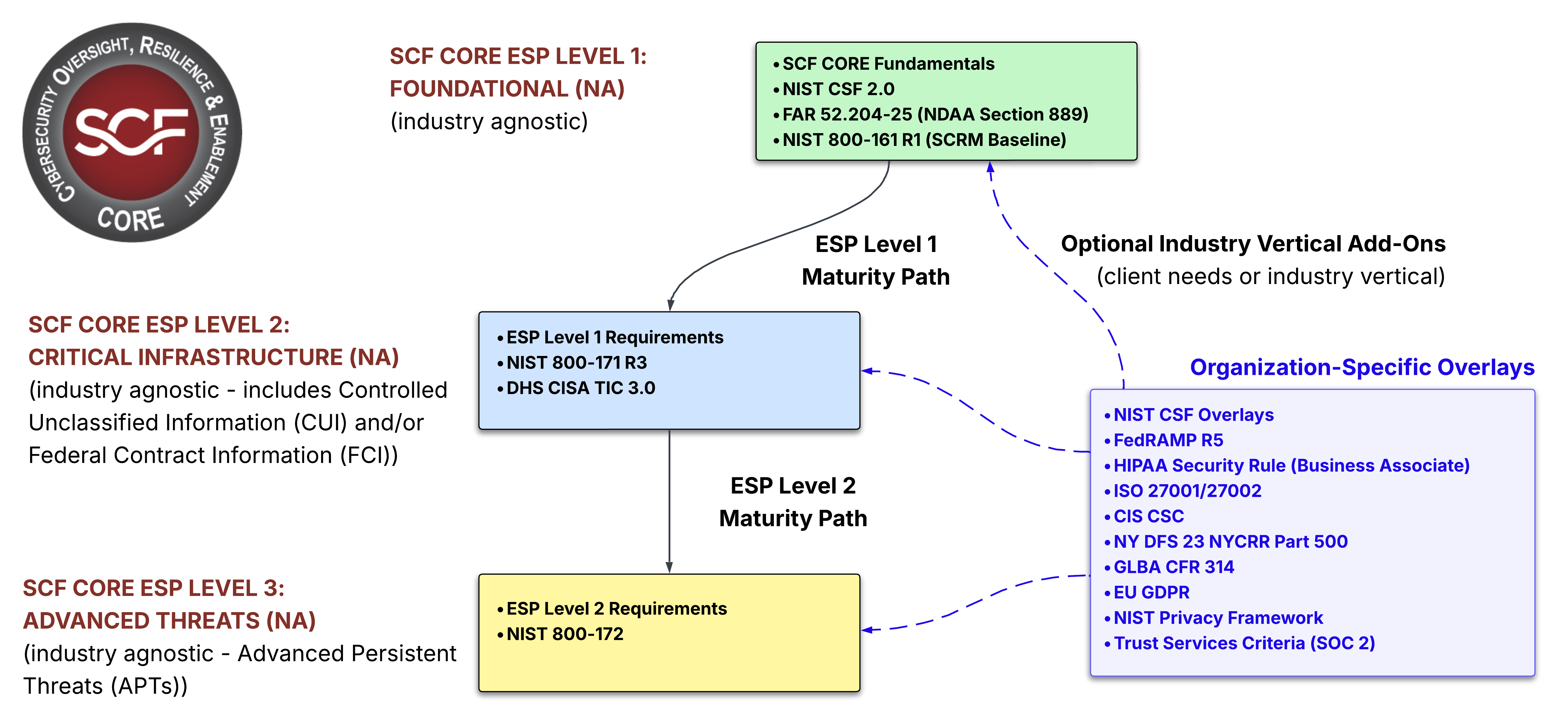
There are three CORE ESP levels defined for the North America (NA) market:
1. Fundamental;
2. Critical Infrastructure; and
3. Advanced Threats

Note: ESPs with a valid CMMC Level 2 certification can apply applicable controls towards the ESP Level 2 certification.
Infographic explaining the Secure Controls Framework (SCF) Cybersecurity Baselines for Market Leading External Service Providers, showing ESP Baseline Determination Flow Chart and ESP Baseline Scoping & Add-On Capabilities with SCF core levels and maturity phases.
Diagram showing SCF Core ESP Levels 1 to 3 with requirements and organization-specific overlays; Level 1 includes SCF CORE fundamentals, NIST CSF 2.0, FAR 52.204-25, NIST 800-161R1; Level 2 includes ESP Level 1 requirements, NIST 800-171 R3, DHS CISA TIC 3.0; Level 3 includes ESP Level 2 requirements and NIST 800-172; overlays include NIST CSF Overlays, FedRAMP R5, HIPAA Security Rule, ISO 27001/27002, CIS CSC, NY DFS 23 NYCRR Part 500, GLBA CFR 314, EU GDPR, NIST Privacy Framework, and Trust Services Criteria (SOC 2).
2025 Roadmap

SCF CORE Roadmap: 7 Tailored Control Sets

Each CORE set targets a distinct organization type, risk profile, or operational context, derived from the full Common Controls Framework® (CCF) catalog using STRM methodology.

SCF CORE Fundamentals

68 controls across 20 of the 34 SCF domains for smaller entities. Specifically designed to meet Texas SB 2610 reasonable cybersecurity requirements.

SCF CORE MA&D

Mergers, Acquisitions & Divestitures control set covering cybersecurity requirements specific to M&A transaction environments.

SCF CORE ESP Level 1

Essential Security Practices: Foundational control set for organizations beginning their cybersecurity program journey.

SCF CORE ESP Level 2

Essential Security Practices: Critical Infrastructure control set for organizations operating critical systems and services.

SCF CORE ESP Level 3

Essential Security Practices: Advanced Threats control set for organizations facing sophisticated threat actor activity.

SCF CORE AI-Enabled Operations

AI-specific cybersecurity controls for organizations augmenting AI capabilities into business operations.

SCF CORE AI Model Deployment

AI-specific cybersecurity controls for organizations developing and/or deploying AI/ML capabilities into business operations (e.g., custom chatbot).

SCF CORE Fundamentals

Small & Medium Business (SMB)-Focused Controls

SCF CORE Fundamentals focuses on the domains most critical for SMB cybersecurity programs. Each control is drawn from the full CCF and calibrated to SMB implementation realities.

When used for TPRM, CORE Fundamentals provides a structured questionnaire framework with built-in weighting based on control criticality.

MCR

Minimum Compliance Requirements

Controls that represent the minimum bar required by external obligations such as laws, regulations, and contracts. These are non-negotiable. Not implementing them creates legal or contractual exposure.

  • Externally influenced (laws, regs, contracts)
  • "Must have" requirements (e.g., non-discretionary)
  • Fact-finding, not risk assessment
  • Forms compliance baseline

DSR

Discretionary Security Requirements

Controls selected based on the organization's own risk appetite and judgment. These go beyond the minimum and represent best-practice enhancements driven by internal risk management.

  • Internally influenced (risk-based decisions)
  • "Nice to have" (e.g., risk-informed choices, discretionary)
  • Based on threat landscape and asset sensitivity
  • Elevates posture beyond compliance floor
Control Catalog

SCF CORE Fundamentals Controls

Organized by domain. Each control is drawn from the full CCF and calibrated to SMB implementation realities. Below are the SCF CORE Fundamentals controls, updated as of the 2026.2 version of the SCF.

Grouping
GroupingRisk #RiskSCF domains addressedControls
Access ControlR-AC-1Loss of Accountability / Attribution
Artificial Intelligence & Autonomous Technologies, Asset Management, Business Continuity & Disaster Recovery, Change Management, Cloud Security, Compliance, Configuration Management, Continuous Monitoring, Cryptographic Protections, Data Classification & Handling, Embedded Technology, Identification & Authentication, Incident Response, Maintenance, Network Security, Physical & Environmental Security, Data Privacy, Technology Development & Acquisition, Threat Management
83
R-AC-2Excessive or Unauthorized Privilege
Artificial Intelligence & Autonomous Technologies, Asset Management, Business Continuity & Disaster Recovery, Change Management, Cloud Security, Compliance, Configuration Management, Continuous Monitoring, Data Classification & Handling, Human Resources Security, Identification & Authentication, Maintenance, Network Security, Physical & Environmental Security, Quantum Security, Secure Engineering & Architecture, Technology Development & Acquisition, Third-Party Management, Vulnerability & Patch Management
85
R-AC-3Unauthorized Privilege ElevationArtificial Intelligence & Autonomous Technologies, Configuration Management, Embedded Technology, Identification & Authentication, Maintenance, Secure Engineering & Architecture, Technology Development & Acquisition31
R-AC-4Unauthorized Access
Security, Compliance & Resilience Governance, Artificial Intelligence & Autonomous Technologies, Asset Management, Business Continuity & Disaster Recovery, Cloud Security, Compliance, Configuration Management, Continuous Monitoring, Data Classification & Handling, Embedded Technology, Endpoint Security, Human Resources Security, Identification & Authentication, Incident Response, Maintenance, Mobile Device Management, Network Security, Physical & Environmental Security, Data Privacy, Quantum Security, Secure Engineering & Architecture, Security Operations, Technology Development & Acquisition, Third-Party Management, Vulnerability & Patch Management, Web Security
282
R-AC-5Identity Compromise / Impersonation
Artificial Intelligence & Autonomous Technologies, Configuration Management, Continuous Monitoring, Cryptographic Protections, Embedded Technology, Endpoint Security, Identification & Authentication, Maintenance, Network Security, Physical & Environmental Security, Data Privacy, Quantum Security, Secure Engineering & Architecture, Third-Party Management, Web Security
96
Asset ManagementR-AM-1Loss, Theft or Damage of AssetsAsset Management, Business Continuity & Disaster Recovery, Data Classification & Handling, Embedded Technology, Human Resources Security, Maintenance, Physical & Environmental Security46
R-AM-2Unauthorized Modification / Loss of System Integrity
Artificial Intelligence & Autonomous Technologies, Asset Management, Business Continuity & Disaster Recovery, Change Management, Configuration Management, Continuous Monitoring, Cryptographic Protections, Data Classification & Handling, Embedded Technology, Endpoint Security, Human Resources Security, Identification & Authentication, Maintenance, Mobile Device Management, Network Security, Physical & Environmental Security, Project & Resource Management, Quantum Security, Secure Engineering & Architecture, Security Operations, Technology Development & Acquisition, Third-Party Management, Vulnerability & Patch Management, Web Security
103
R-AM-3Unauthorized Retention / Inability to Dispose of Data
Artificial Intelligence & Autonomous Technologies, Asset Management, Business Continuity & Disaster Recovery, Cloud Security, Continuous Monitoring, Cryptographic Protections, Data Classification & Handling, Incident Response, Mobile Device Management, Physical & Environmental Security, Data Privacy, Secure Engineering & Architecture, Technology Development & Acquisition, Third-Party Management, Web Security
49
Business ContinuityR-BC-1Business / Service Interruption
Artificial Intelligence & Autonomous Technologies, Business Continuity & Disaster Recovery, Capacity & Performance Planning, Change Management, Embedded Technology, Information Assurance, Network Security, Physical & Environmental Security, Secure Engineering & Architecture, Security Operations, Third-Party Management, Vulnerability & Patch Management
46
R-BC-2Data Loss / Integrity Compromise
Artificial Intelligence & Autonomous Technologies, Asset Management, Business Continuity & Disaster Recovery, Cloud Security, Continuous Monitoring, Cryptographic Protections, Data Classification & Handling, Security Operations, Technology Development & Acquisition
32
R-BC-3Reduced Operational Productivity
Artificial Intelligence & Autonomous Technologies, Business Continuity & Disaster Recovery, Capacity & Performance Planning, Compliance, Incident Response, Information Assurance, Network Security, Security Awareness & Training
10
R-BC-4System / Data Compromise (Technical Vector)
Security, Compliance & Resilience Governance, Artificial Intelligence & Autonomous Technologies, Asset Management, Capacity & Performance Planning, Configuration Management, Continuous Monitoring, Data Classification & Handling, Embedded Technology, Endpoint Security, Incident Response, Maintenance, Network Security, Secure Engineering & Architecture, Security Awareness & Training, Technology Development & Acquisition, Vulnerability & Patch Management, Web Security
82
R-BC-5System / Data Compromise (Non-Technical Vector)
Asset Management, Configuration Management, Continuous Monitoring, Data Classification & Handling, Embedded Technology, Human Resources Security, Maintenance, Network Security, Physical & Environmental Security, Data Privacy, Security Awareness & Training, Technology Development & Acquisition, Threat Management
24
ExposureR-EX-1Revenue Loss0
R-EX-2Contractual Default / TerminationAsset Management, Compliance, Configuration Management, Data Classification & Handling, Incident Response, Information Assurance, Data Privacy, Third-Party Management17
R-EX-3Loss of Competitive Advantage0
R-EX-4Reputational Harm / Loss of Stakeholder TrustArtificial Intelligence & Autonomous Technologies, Compliance, Incident Response, Network Security4
R-EX-5Regulatory / Legal / Contractual Financial Liability
Security, Compliance & Resilience Governance, Artificial Intelligence & Autonomous Technologies, Asset Management, Cloud Security, Compliance, Configuration Management, Cryptographic Protections, Data Classification & Handling, Human Resources Security, Identification & Authentication, Incident Response, Information Assurance, Physical & Environmental Security, Data Privacy, Risk Management, Secure Engineering & Architecture, Technology Development & Acquisition, Third-Party Management
178
R-EX-6Exposure from Unaddressed Vulnerabilities
Artificial Intelligence & Autonomous Technologies, Asset Management, Configuration Management, Embedded Technology, Endpoint Security, Incident Response, Information Assurance, Network Security, Quantum Security, Risk Management, Technology Development & Acquisition, Threat Management, Vulnerability & Patch Management
69
R-EX-7System / Service Compromise
Security, Compliance & Resilience Governance, Configuration Management, Continuous Monitoring, Embedded Technology, Endpoint Security, Network Security, Secure Engineering & Architecture, Technology Development & Acquisition, Vulnerability & Patch Management, Web Security
61
R-EX-8Failure to Achieve Strategic / Mission ObjectivesArtificial Intelligence & Autonomous Technologies, Project & Resource Management3
R-EX-9Intellectual Property / Trade Secret Loss
Security, Compliance & Resilience Governance, Artificial Intelligence & Autonomous Technologies, Asset Management, Data Classification & Handling, Network Security, Physical & Environmental Security, Vulnerability & Patch Management
9
R-EX-10Fraud / Theft / Direct Financial LossArtificial Intelligence & Autonomous Technologies, Continuous Monitoring, Human Resources Security, Identification & Authentication4
R-EX-11Loss of Authorization / Certification / License
Security, Compliance & Resilience Governance, Artificial Intelligence & Autonomous Technologies, Compliance, Embedded Technology, Identification & Authentication, Information Assurance, Data Privacy, Quantum Security, Technology Development & Acquisition
36
GovernanceR-GV-1Failure to Support Business / Mission ObjectivesSecurity, Compliance & Resilience Governance, Artificial Intelligence & Autonomous Technologies, Cloud Security, Secure Engineering & Architecture, Security Operations, Technology Development & Acquisition9
R-GV-2Unaddressed Security / Compliance Exposure
Security, Compliance & Resilience Governance, Artificial Intelligence & Autonomous Technologies, Asset Management, Business Continuity & Disaster Recovery, Capacity & Performance Planning, Change Management, Cloud Security, Compliance, Configuration Management, Continuous Monitoring, Cryptographic Protections, Data Classification & Handling, Embedded Technology, Endpoint Security, Human Resources Security, Identification & Authentication, Information Assurance, Mobile Device Management, Network Security, Physical & Environmental Security, Data Privacy, Project & Resource Management, Quantum Security, Risk Management, Secure Engineering & Architecture, Security Operations, Technology Development & Acquisition, Third-Party Management, Threat Management, Vulnerability & Patch Management
196
R-GV-3Unperformed / Unowned Control Responsibilities
Security, Compliance & Resilience Governance, Artificial Intelligence & Autonomous Technologies, Asset Management, Business Continuity & Disaster Recovery, Capacity & Performance Planning, Change Management, Cloud Security, Compliance, Configuration Management, Continuous Monitoring, Cryptographic Protections, Data Classification & Handling, Embedded Technology, Endpoint Security, Human Resources Security, Identification & Authentication, Incident Response, Information Assurance, Maintenance, Mobile Device Management, Network Security, Physical & Environmental Security, Data Privacy, Project & Resource Management, Quantum Security, Risk Management, Secure Engineering & Architecture, Security Operations, Security Awareness & Training, Technology Development & Acquisition, Third-Party Management, Threat Management, Vulnerability & Patch Management, Web Security
122
R-GV-4Uncontrolled Internal Security / Privacy Exposure
Security, Compliance & Resilience Governance, Artificial Intelligence & Autonomous Technologies, Change Management, Cloud Security, Data Classification & Handling, Embedded Technology, Human Resources Security, Incident Response, Mobile Device Management, Network Security, Physical & Environmental Security, Data Privacy, Risk Management, Secure Engineering & Architecture, Security Operations, Technology Development & Acquisition, Threat Management, Vulnerability & Patch Management, Web Security
46
R-GV-5Uncontrolled Third-Party Security / Privacy Exposure
Artificial Intelligence & Autonomous Technologies, Asset Management, Business Continuity & Disaster Recovery, Cloud Security, Compliance, Continuous Monitoring, Data Classification & Handling, Human Resources Security, Identification & Authentication, Incident Response, Network Security, Data Privacy, Quantum Security, Risk Management, Technology Development & Acquisition, Third-Party Management
70
R-GV-6Lack of oversight of internal controls
Security, Compliance & Resilience Governance, Artificial Intelligence & Autonomous Technologies, Asset Management, Business Continuity & Disaster Recovery, Change Management, Compliance, Configuration Management, Continuous Monitoring, Cryptographic Protections, Data Classification & Handling, Embedded Technology, Endpoint Security, Human Resources Security, Incident Response, Information Assurance, Maintenance, Network Security, Data Privacy, Project & Resource Management, Quantum Security, Risk Management, Technology Development & Acquisition, Vulnerability & Patch Management
113
R-GV-7Lack of oversight of third-party controls
Artificial Intelligence & Autonomous Technologies, Cloud Security, Compliance, Data Classification & Handling, Human Resources Security, Identification & Authentication, Information Assurance, Quantum Security, Risk Management, Third-Party Management
25
R-GV-8Harm from Illegal, Abusive or Unsafe Content / ConductArtificial Intelligence & Autonomous Technologies, Compliance, Network Security14
R-GV-9Inability to Demonstrate Due Diligence / Due Care
Security, Compliance & Resilience Governance, Artificial Intelligence & Autonomous Technologies, Asset Management, Business Continuity & Disaster Recovery, Capacity & Performance Planning, Change Management, Cloud Security, Compliance, Configuration Management, Continuous Monitoring, Cryptographic Protections, Data Classification & Handling, Embedded Technology, Endpoint Security, Human Resources Security, Identification & Authentication, Incident Response, Information Assurance, Maintenance, Mobile Device Management, Network Security, Physical & Environmental Security, Data Privacy, Project & Resource Management, Quantum Security, Risk Management, Secure Engineering & Architecture, Security Operations, Security Awareness & Training, Technology Development & Acquisition, Third-Party Management, Threat Management, Vulnerability & Patch Management, Web Security
274
R-GV-10Unreliable Assurance / Decision Information
Security, Compliance & Resilience Governance, Artificial Intelligence & Autonomous Technologies, Asset Management, Business Continuity & Disaster Recovery, Change Management, Compliance, Configuration Management, Continuous Monitoring, Endpoint Security, Incident Response, Information Assurance, Data Privacy, Project & Resource Management, Quantum Security, Risk Management, Security Awareness & Training, Technology Development & Acquisition, Third-Party Management, Threat Management, Vulnerability & Patch Management
148
Incident ResponseR-IR-1Loss of Investigative / Evidentiary Capability
Artificial Intelligence & Autonomous Technologies, Asset Management, Cloud Security, Compliance, Continuous Monitoring, Data Classification & Handling, Embedded Technology, Endpoint Security, Human Resources Security, Identification & Authentication, Incident Response, Maintenance, Physical & Environmental Security, Secure Engineering & Architecture, Technology Development & Acquisition, Vulnerability & Patch Management
70
R-IR-2Delayed Containment / Increased Incident Impact
Security, Compliance & Resilience Governance, Artificial Intelligence & Autonomous Technologies, Business Continuity & Disaster Recovery, Cloud Security, Configuration Management, Continuous Monitoring, Endpoint Security, Incident Response, Mobile Device Management, Network Security, Physical & Environmental Security, Security Operations, Security Awareness & Training, Third-Party Management, Threat Management, Vulnerability & Patch Management, Web Security
71
R-IR-3Incident Persistence / Recurrence
Artificial Intelligence & Autonomous Technologies, Asset Management, Business Continuity & Disaster Recovery, Configuration Management, Endpoint Security, Identification & Authentication, Incident Response, Risk Management, Secure Engineering & Architecture, Technology Development & Acquisition, Vulnerability & Patch Management
29
R-IR-4Incident Response / Recovery Cost0
Operational ResilienceR-OR-1Recovery Failure / Unacceptable Recovery Delay
Asset Management, Business Continuity & Disaster Recovery, Capacity & Performance Planning, Configuration Management, Cryptographic Protections, Embedded Technology, Incident Response, Maintenance, Physical & Environmental Security, Secure Engineering & Architecture, Third-Party Management
56
R-OR-2Concentration / Single-Point Dependency Failure
Artificial Intelligence & Autonomous Technologies, Asset Management, Business Continuity & Disaster Recovery, Capacity & Performance Planning, Cloud Security, Continuous Monitoring, Human Resources Security, Network Security, Physical & Environmental Security, Secure Engineering & Architecture, Technology Development & Acquisition, Third-Party Management
31
Situational AwarenessR-SA-1Undetected / Delayed Detection of Adverse Activity
Security, Compliance & Resilience Governance, Artificial Intelligence & Autonomous Technologies, Asset Management, Capacity & Performance Planning, Change Management, Cloud Security, Compliance, Configuration Management, Continuous Monitoring, Cryptographic Protections, Data Classification & Handling, Embedded Technology, Endpoint Security, Human Resources Security, Identification & Authentication, Incident Response, Maintenance, Mobile Device Management, Network Security, Physical & Environmental Security, Data Privacy, Project & Resource Management, Quantum Security, Secure Engineering & Architecture, Security Operations, Security Awareness & Training, Technology Development & Acquisition, Third-Party Management, Threat Management, Vulnerability & Patch Management, Web Security
181
R-SA-2Lack of a security-minded workforce
Security, Compliance & Resilience Governance, Artificial Intelligence & Autonomous Technologies, Asset Management, Data Classification & Handling, Human Resources Security, Identification & Authentication, Incident Response, Data Privacy, Risk Management, Security Awareness & Training, Technology Development & Acquisition, Threat Management
45
Supply ChainR-SC-1Third-Party Cybersecurity Compromise / ExposureArtificial Intelligence & Autonomous Technologies, Asset Management, Configuration Management, Incident Response, Network Security, Third-Party Management, Vulnerability & Patch Management14
R-SC-2Third-Party Physical Security Disruption / Exposure0
R-SC-3Sub-Tier / Fourth-Party Supply Chain ExposureBusiness Continuity & Disaster Recovery, Quantum Security, Technology Development & Acquisition, Third-Party Management8
R-SC-4Third-Party Legal / Compliance ExposureArtificial Intelligence & Autonomous Technologies, Asset Management, Data Privacy, Third-Party Management4
R-SC-5Harm from Unauthorized / Unintended Product or Service Use
Security, Compliance & Resilience Governance, Artificial Intelligence & Autonomous Technologies, Asset Management, Cloud Security, Compliance, Configuration Management, Embedded Technology, Human Resources Security, Project & Resource Management, Security Operations, Technology Development & Acquisition
21
R-SC-6Third-Party Dependency FailureArtificial Intelligence & Autonomous Technologies, Asset Management, Business Continuity & Disaster Recovery, Technology Development & Acquisition, Third-Party Management16
R-SC-7Counterfeit / Non-Conforming Component Impact
Artificial Intelligence & Autonomous Technologies, Asset Management, Change Management, Configuration Management, Security Awareness & Training, Technology Development & Acquisition, Third-Party Management, Vulnerability & Patch Management
14
Artificial Intelligence & Autonomous TechnologiesR-AI-1AI Output / Decision Integrity FailureArtificial Intelligence & Autonomous Technologies, Identification & Authentication43
R-AI-2AI Data Confidentiality / Integrity / Provenance LossArtificial Intelligence & Autonomous Technologies21
R-AI-3Unauthorized / Harmful Autonomous ActionArtificial Intelligence & Autonomous Technologies, Embedded Technology23
R-AI-4Sensitive Data / Compliance Exposure from Unsanctioned AI UseArtificial Intelligence & Autonomous Technologies, Asset Management, Compliance12
R-AI-5Unintended or Unsafe Technology BehaviorArtificial Intelligence & Autonomous Technologies, Embedded Technology37
R-AI-6AI Bias / Discriminatory OutcomeArtificial Intelligence & Autonomous Technologies, Data Classification & Handling19
Operational Technology (OT)R-OT-1OT Safety / Process Availability FailureEmbedded Technology9
Information ProtectionR-IP-1Long-Term Confidentiality Loss from Cryptographic ObsolescenceBusiness Continuity & Disaster Recovery, Cryptographic Protections, Data Classification & Handling, Incident Response, Network Security, Quantum Security, Technology Development & Acquisition, Web Security34
R-IP-2Loss of Confidentiality
Security, Compliance & Resilience Governance, Artificial Intelligence & Autonomous Technologies, Asset Management, Business Continuity & Disaster Recovery, Cloud Security, Compliance, Configuration Management, Continuous Monitoring, Cryptographic Protections, Data Classification & Handling, Embedded Technology, Endpoint Security, Human Resources Security, Identification & Authentication, Incident Response, Information Assurance, Maintenance, Mobile Device Management, Network Security, Physical & Environmental Security, Data Privacy, Quantum Security, Secure Engineering & Architecture, Technology Development & Acquisition, Third-Party Management, Vulnerability & Patch Management, Web Security
196
R-IP-3Loss of Data Integrity
Artificial Intelligence & Autonomous Technologies, Asset Management, Business Continuity & Disaster Recovery, Cloud Security, Compliance, Configuration Management, Continuous Monitoring, Cryptographic Protections, Data Classification & Handling, Endpoint Security, Maintenance, Mobile Device Management, Network Security, Data Privacy, Secure Engineering & Architecture, Technology Development & Acquisition, Third-Party Management
50
R-IP-4Loss of Data / Service Availability
Artificial Intelligence & Autonomous Technologies, Asset Management, Business Continuity & Disaster Recovery, Capacity & Performance Planning, Change Management, Cloud Security, Cryptographic Protections, Embedded Technology, Incident Response, Network Security, Physical & Environmental Security, Secure Engineering & Architecture, Third-Party Management, Web Security
52
R-IP-5Loss of Authenticity / Provenance
Artificial Intelligence & Autonomous Technologies, Asset Management, Change Management, Compliance, Configuration Management, Continuous Monitoring, Cryptographic Protections, Data Classification & Handling, Embedded Technology, Endpoint Security, Identification & Authentication, Incident Response, Network Security, Data Privacy, Quantum Security, Secure Engineering & Architecture, Technology Development & Acquisition, Vulnerability & Patch Management
64
R-IP-6Privacy Harm / Unauthorized Processing
Artificial Intelligence & Autonomous Technologies, Cloud Security, Compliance, Configuration Management, Continuous Monitoring, Data Classification & Handling, Identification & Authentication, Incident Response, Network Security, Physical & Environmental Security, Data Privacy, Risk Management, Technology Development & Acquisition, Third-Party Management
140
SafetyR-SF-1Injury / Loss of LifeArtificial Intelligence & Autonomous Technologies, Embedded Technology, Physical & Environmental Security12
R-SF-2Physical / Environmental DamageEmbedded Technology, Physical & Environmental Security16
PersonnelR-PE-1Loss of Critical Knowledge / Capability
Security, Compliance & Resilience Governance, Artificial Intelligence & Autonomous Technologies, Business Continuity & Disaster Recovery, Human Resources Security, Data Privacy, Project & Resource Management, Risk Management, Security Awareness & Training, Technology Development & Acquisition, Third-Party Management
28
Control ID
Control Name
Brief Description
GOV: Governance (3 Controls)
GOV-02
Publishing Security, Compliance & Resilience Documentation
Mechanisms exist to establish, maintain and disseminate policies, standards and procedures necessary for secure, compliant and resilient capabilities.
GOV-04
Assigned Security, Compliance & Resilience Responsibilities
Mechanisms exist to assign one or more qualified individuals with the mission and resources to centrally-manage, coordinate, develop, implement and maintain an enterprise-wide Security, Compliance & Resilience Program (SCRP).
GOV-15
Operationalizing Security, Compliance &  Resilience Capabilities
Mechanisms exist to compel data and/or process owners to operationalize security, compliance and resilience practices for each Technology Asset, Application and/or Service (TAAS) under their control.
AST: Asset Management (5 Controls)
AST-02
Asset Inventories
Mechanisms exist to perform inventories of Technology Assets, Applications, Services and/or Data (TAASD) that:
(1) Accurately reflects the current TAASD in use;
(2) Identifies authorized software products, including business justification details;
(3) Is at the level of granularity deemed necessary for tracking and reporting;
(4) Includes organization-defined information deemed necessary to achieve effective property accountability; and
(5) Is available for review and audit by designated organizational personnel.
AST-02.8
Data Action Mapping
Mechanisms exist to create and maintain a map of Technology Assets, Applications and/or Services (TAAS) where sensitive/regulated data is stored, transmitted or processed.
AST-04
Network Diagrams & Data Flow Diagrams (DFDs)
Mechanisms exist to maintain network architecture diagrams that:
(1) Contain sufficient detail to assess the security of the network's architecture;
(2) Reflect the current architecture of the network environment; and
(3) Document all sensitive/regulated data flows.
AST-09
Secure Disposal, Destruction or Re-Use of Equipment
Mechanisms exist to securely dispose of, destroy or repurpose system components using organization-defined techniques and methods to prevent information being recovered from these components.
AST-16
Bring Your Own Device (BYOD) Usage
Mechanisms exist to implement and govern a Bring Your Own Device (BYOD) program to reduce risk associated with personally-owned devices in the workplace.
BCD: Business Continuity & Disaster Recovery (2 Controls)
BCD-04
Contingency Plan Testing & Exercises
Mechanisms exist to conduct tests and/or exercises to evaluate the contingency plan's effectiveness and the organization's readiness to execute the plan.
BCD-11
Data Backups
Mechanisms exist to create recurring backups of data, software and/or system images, as well as verify the integrity of these backups, to ensure the availability of the data to satisfy Recovery Time Objectives (RTOs) and Recovery Point Objectives (RPOs).
CHG: Change Management (2 Controls)
CHG-02
Configuration Change Control
Mechanisms exist to govern the technical configuration change control processes.
CHG-03
Security Impact Analysis for Changes
Mechanisms exist to analyze proposed changes for potential security impacts, prior to the implementation of the change.
CLD: Cloud Security (2 Controls)
CLD-01
Cloud Services
Mechanisms exist to facilitate the implementation of cloud management controls to ensure cloud instances are secure and in-line with industry practices.
CLD-10
Sensitive Data In Public Cloud Providers
Mechanisms exist to limit and manage the storage of sensitive/regulated data in public cloud providers.
CPL: Compliance (1 Control)
CPL-01
Statutory, Regulatory & Contractual Compliance
Mechanisms exist to facilitate the identification and implementation of relevant statutory, regulatory and contractual controls.
CFG: Configuration Management (2 Controls)
CFG-02
Secure Baseline Configurations
Mechanisms exist to develop, document and maintain secure baseline configurations for Technology Assets, Applications and/or Services (TAAS) that are consistent with industry-accepted system hardening standards.
CFG-03
Least Functionality
Mechanisms exist to configure systems to provide only essential capabilities by specifically prohibiting or restricting the use of ports, protocols, and/or services.
MON: Continuous Monitoring (3 Controls)
MON-01.8
Security Event Monitoring
Mechanisms exist to review event logs on an ongoing basis and escalate incidents in accordance with established timelines and procedures.
MON-03
Content of Event Logs
Mechanisms exist to configure Technology Assets, Applications and/or Services (TAAS) to produce event logs that contain sufficient information to, at a minimum:
(1) Establish what type of event occurred;
(2) When (date and time) the event occurred;
(3) Where the event occurred;
(4) The source of the event;
(5) The outcome (success or failure) of the event; and
(6) The identity of any user/subject associated with the event.
MON-16
Anomalous Behavior
Mechanisms exist to utilize User & Entity Behavior Analytics (UEBA) and/or User Activity Monitoring (UAM) solutions to detect and respond to anomalous behavior that could indicate account compromise or other malicious activities.
CRY - Cryptographic Protections (3 Controls)
CRY-03
Transmission Confidentiality
Cryptographic mechanisms exist to protect the confidentiality of data being transmitted.
CRY-05
Encrypting Data At Rest
Cryptographic mechanisms exist to prevent unauthorized disclosure of data at rest.
CRY-09
Cryptographic Key Management
Mechanisms exist to facilitate cryptographic key management controls to protect the confidentiality, integrity and availability of keys.
DCH - Data Classification & Handling (5 Controls)
DCH-01.2
Sensitive / Regulated Data Protection
Mechanisms exist to protect sensitive/regulated data wherever it is processed and/or stored.
DCH-01.4
Defining Access Authorizations for Sensitive / Regulated Data
Mechanisms exist to explicitly define authorizations for specific individuals and/or roles for logical and /or physical access to sensitive/regulated data.
DCH-02
Data & Asset Classification
Mechanisms exist to ensure data and assets are categorized in accordance with applicable statutory, regulatory and contractual requirements.
DCH-13
Use of External Technology Assets, Applications and/or Services (TAAS)
Mechanisms exist to govern how external parties, including Technology Assets, Applications and/or Services (TAAS), are used to securely store, process and transmit data.
DCH-17
Ad-Hoc Transfers
Mechanisms exist to secure ad-hoc exchanges of large digital files with internal or external parties.
END - Endpoint Security (2 Controls)
END-04
Malicious Code Protection (Anti-Malware)
Mechanisms exist to utilize antimalware technologies to detect and eradicate malicious code.
END-08
Phishing & Spam Protection
Mechanisms exist to utilize anti-phishing and spam protection technologies to detect and take action on unsolicited messages transported by electronic mail.
HRS - Human Resources Security (2 Controls)
HRS-04
Personnel Screening
Mechanisms exist to manage personnel security risk by screening individuals prior to authorizing access.
HRS-05
Terms of Employment
Mechanisms exist to require all employees and contractors to apply cybersecurity and data protection principles in their daily work to enable secure, compliant and resilient capabilities.
IAC - Identification & Authentication Domain (10 Controls)
IAC-01.3
User & Service Account Inventories
Mechanisms exist to maintain a current list of authorized users and service accounts.
IAC-06
Multi-Factor Authentication (MFA)
Automated mechanisms exist to enforce Multi-Factor Authentication (MFA) for:
(1) Remote network access;
(2) Third-party Technology Assets, Applications and/or Services (TAAS); and/ or
(3) Non-console access to critical TAAS that store, transmit and/or process sensitive/regulated data.
IAC-07
User Provisioning & De-Provisioning
Mechanisms exist to utilize a formal user registration and de-registration process that governs the assignment of access rights.
IAC-08
Role-Based Access Control (RBAC)
Mechanisms exist to enforce Role-Based Access Control (RBAC) for Technology Assets, Applications, Services and/or Data (TAASD) to restrict access to individuals assigned specific roles with legitimate business needs.
IAC-10
Authenticator Management
Mechanisms exist to:(1) Securely manage authenticators for users and devices; and(2) Ensure the strength of authentication is appropriate to the classification of the data being accessed.
IAC-10.8
Default Authenticators
Mechanisms exist to ensure default authenticators are changed as part of account creation or system installation.
IAC-15
Account Management
Mechanisms exist to proactively govern account management of individual, group, system, service, application, guest and temporary accounts.
IAC-16
Privileged Account Management (PAM)
Mechanisms exist to restrict and control privileged access rights for users and Technology Assets, Applications and/or Services (TAAS).
IAC-17
Periodic Review of Account Privileges
Mechanisms exist to periodically-review the privileges assigned to individuals and service accounts to validate the need for such privileges and reassign or remove unnecessary privileges, as necessary.
IAC-21
Least Privilege
Mechanisms exist to utilize the concept of least privilege, allowing only authorized access to processes necessary to accomplish assigned tasks in accordance with organizational business functions.
IRO - Incident Response (2 Controls)
IAC-02
Incident Handling
Mechanisms exist to cover:
(1) Preparation;
(2) Automated event detection or manual incident report intake;
(3) Analysis;
(4) Containment;
(5) Eradication; and
(6) Recovery.
IAC-04
Incident Response Plan (IRP)
Mechanisms exist to maintain and make available a current and viable Incident Response Plan (IRP) to all stakeholders.
NET - Network Security (8 Controls)
NET-02
Layered Network Defenses
Mechanisms exist to implement security functions as a layered structure that minimizes interactions between layers of the design and avoids any dependence by lower layers on the functionality or correctness of higher layers.
NET-02.2
Guest Networks
Mechanisms exist to implement and manage a secure guest network.
NET-03
Boundary Protection
Mechanisms exist to monitor and control communications at the external network boundary and at key internal boundaries within the network.
NET-04
Data Flow Enforcement – Access Control Lists (ACLs)
Mechanisms exist to implement and govern Access Control Lists (ACLs) to provide data flow enforcement that explicitly restrict network traffic to only what is authorized.
NET-14
Remote Access
Mechanisms exist to define, control and review organization-approved, secure remote access methods.
NET-14.5
Work From Anywhere (WFA) - Telecommuting Security
Mechanisms exist to define secure telecommuting practices and govern remote access to Technology Assets, Applications, Services and/or Data (TAASD) for remote workers.
NET-15
Wireless Networking
Mechanisms exist to control authorized wireless usage and monitor for unauthorized wireless access.
NET-18
DNS & Content Filtering
Mechanisms exist to force Internet-bound network traffic through a proxy device (e.g., Policy Enforcement Point (PEP)) for URL content filtering and DNS filtering to limit a user's ability to connect to dangerous or prohibited Internet sites.
PES - Physical & Environmental Security (3 Controls)
PES-02
Physical Access Authorizations
Physical access control mechanisms exist to maintain a current list of personnel with authorized access to organizational facilities (except for those areas within the facility officially designated as publicly accessible).
PES-03
Physical Access Control
Physical access control mechanisms exist to enforce physical access authorizations for all physical access points (including designated entry/exit points) to facilities (excluding those areas within the facility officially designated as publicly accessible).
PES-06
Visitor Control
Physical access control mechanisms exist to identify, authorize and monitor visitors before allowing access to the facility (other than areas designated as publicly accessible).
RSK - Risk Management (4 Controls)
RSK-03
Risk Identification
Mechanisms exist to identify and document risks, both internal and external.
RSK-04
Risk Assessment
Mechanisms exist to conduct recurring assessments of risk that includes the likelihood and magnitude of harm, from unauthorized access, use, disclosure, disruption, modification or destruction of the organization's Technology Assets, Applications, Services and/or Data (TAASD).
RSK-4.1
Risk Register
Mechanisms exist to maintain a risk register that facilitates monitoring and reporting of risks.
RSK-06
Risk Remediation
Mechanisms exist to remediate risks to an acceptable level.
SAT - Security Awareness & Training (1 Control)
SAT-02
Security, Compliance & Resilience Awareness Training
Mechanisms exist to provide all employees and contractors appropriate security, compliance and resilience awareness education and training that is relevant for their job function.
TPM - Third-Party Management (5 Controls)
TPM-01.1
Third-Party Inventories
Mechanisms exist to maintain a current, accurate and complete list of External Service Providers (ESPs) that can potentially impact the Confidentiality, Integrity, Availability and/or Safety (CIAS) of the organization's Technology Assets, Applications, Services and/or Data (TAASD).
TPM-03
Supply Chain Risk Management (SCRM)
MecMechanisms exist to:
(1) Evaluate security risks and threats associated with Technology Assets, Applications and/or Services (TAAS) supply chains; and
(2) Take appropriate remediation actions to minimize the organization's exposure to those risks and threats, as necessary.hanisms exist to remediate risks to an acceptable level.
TPM-05
Third-Party Contract Requirements
Mechanisms exist to require contractual requirements for applicable security, compliance and resilience requirements with third-parties, reflecting the organization's needs to protect its Technology Assets, Applications, Services and/or Data (TAASD).
TPM-05.4
Responsible, Accountable, Supportive, Consulted & Informed (RASCI) Matrix
Mechanisms exist to document and maintain a Responsible, Accountable, Supportive, Consulted & Informed (RASCI) matrix, or similar documentation, to delineate assignment for security, compliance and resilience controls between internal stakeholders and External Service Providers (ESPs).
TPM-08
Review of Third-Party Services
Mechanisms exist to monitor, regularly review and assess External Service Providers (ESPs) for compliance with established contractual requirements for security, compliance and resilience controls.
VPM - Vulnerability & Patch Management (3 Controls)
VPM-02
Vulnerability Remediation Process
Mechanisms exist to ensure that vulnerabilities are properly identified, tracked and remediated.
VPM-05
Software & Firmware Patching
Mechanisms exist to conduct software patching for all deployed Technology Assets, Applications and/or Services (TAAS), including firmware.
VPM-06
Vulnerability Scanning
Mechanisms exist to detect vulnerabilities and configuration errors by routine vulnerability scanning of systems and applications.
Use Case

Third-Party Risk Management (TPRM)

SCF CORE Fundamentals serves as an effective TPRM baseline. Organizations can use it to assess vendors, suppliers, and service providers against a standardized control set calibrated to SMB realities.

When used for TPRM, CORE Fundamentals provides a structured questionnaire framework, with built-in weighting based on control criticality. The SCF’s External Reference Library (ERL) links each control to authoritative sources for evidence verification.

TPRM Assessment Components in SCF CORE

  • Control questionnaire: Questions are mapped to control objectives.
  • Control weighting: Assists with prioritizing implementation and risk management decisions,
  • External Reference Library (ERL): Reasonable evidence that companies should expect to have.
  • Assessment Observations (AOs): Examiner-focused criteria to evaluate control implementation.
  • Risk and threat catalog crosswalk.
  • Scoring methodology for aggregate risk rating.

TPRM Control Areas

Governance
Asset Management
Identity & Access
Network Security
Cryptography
Endpoint
Incident Response
Third-Party Mgmt
Risk Management
Monitoring
Data Classification
Vulnerability Mgmt

CORE Fundamentals maps directly to common vendor risk questionnaire formats, enabling side-by-side comparison of vendor posture against the SCF baseline.

Assessment & Certification

Third-Party Assessable

SCF CORE Fundamentals is designed to be independently assessed through the SCR Conformity Assessment Program (SCR-CAP). Organizations seeking documented, third-party validated conformity, including for Texas SB 2610 purposes, can engage an SCF-authorized assessor.

SCR-CAP Assessment Guide Covers:

  • Scoping and boundary definition
  • Control-level assessment criteria
  • Evidence collection requirements (ERL-aligned)
  • Assessment Observation (AO) templates
  • Scoring and rating methodology
  • Non-conformance and remediation tracking
  • Conformity statement and report generation
Implementation Cycle

Plan-Do-Check-Act (PDCA)

SCF CORE Fundamentals is designed to operate within a continuous PDCA improvement cycle, not as a one-time compliance exercise.

P

PLAN

Identify applicable controls. Assess current state vs CORE Fundamentals baseline. Define remediation priorities and resource requirements. Establish risk appetite and MCR obligations.

D

DO

Implement controls across all 20 domains. Document policies, standards, and procedures. Deploy technical controls. Train personnel. Engage third-party assessor if pursuing SCR-CAP.

C

CHECK

Monitor control effectiveness. Conduct internal assessments against CORE Fundamentals criteria. Review Evidence Request List (ERL) satisfaction. Validate against MCR obligations.

A

ACT

Remediate gaps identified in the Check phase. Update policies and standards. Elevate from CORE Fundamentals toward higher-maturity control sets (ESP Level 1, 2, 3) as organizational capacity grows.