.png)
A Holistic System for Secure, Compliant & Resilient Business Processes
The Secure Controls Framework® (SCF) Secure, Compliant & Resilient Management System (SCRMS) is intended to be utilized as a holistic, technology-agnostic framework for an entity to design, implement and maintain secure, compliant and resilient capabilities, covering an organization’s People, Processes, Technology, Data and Facilities (PPTDF), regardless of how or where data is stored, processed and/or transmitted.
The SCRMS is not a “one-size-fits-all” playbook. It is designed to be adopted and tailored to the unique size, resources, and risk circumstances of each organization. The SCRMS expands upon and modernizes traditional Information Security Management System (ISMS) models, replacing siloed “management systems” with a single, unified operational framework that governs cybersecurity, data privacy, risk, and compliance together.
By design, the SCRMS expands upon and modernizes the concept of traditional Information Security Management System (ISMS) models, due to the archaic nature of multiple, siloed “management systems” that are necessary to provide reasonable governance practices (e.g., Artificial Intelligence Management System (AIMS) add-on). The use of siloed ISMS, AIMS and similar stand-alone management systems fails to address the reality of modern business practices, since it is overly leveraged for marketing purposes. This does not serve assurance needs to demonstrate security, compliance or resilience that entities require. The SCRMS offers a broader “security, compliance and resilience ecosystem” mindset that is designed to provide the necessary coverage to address applicable risks and threats that entities face.
Without an overarching concept of operations for the broader GRC function, organizations find that their governance, risk, compliance, and privacy teams operate in silos. Unfortunately, that approach produces unclear roles, duplicated effort, and gaps in coverage. The SCRMS directly solves this. The SCRMS enables an entity to align with one, or more, laws, regulations and/or frameworks. For example, an entity that aligns with NIST CSF 2.0, but also has obligations for PCI DSS, ISO 27001, ISO 42001, HIPAA Security Rule and SOC 2 can leverage a “living control set” that is capable of adjusting to the specific security, compliance and resilience requirements it must address.
What Is The SCRMS?
The SCRMS is designed to be:
- Framework-agnostic by allowing entities to leverage one or more frameworks that it needs to align with (e.g., NIST CSF 2.0, SOC 2, NIST 800-171, ISO 27001, etc.);
- Process-focused by support the people, processes, and practices that must exist for a cybersecurity program to operate effectively
- Designed to function by addressing strategic, operational, and tactical dimensions simultaneously
- Supply-chain aware by addressing both internal controls and Cybersecurity Supply Chain Risk Management (C-SCRM)
- Scalable by tailoring from small businesses to large enterprises and government entities
- Unified by replacing siloed ISMS, AIMS, PIMS, and other fragmented management systems with one coherent model
What Does It Mean To Be Secure, Compliant & Resilient?
The SCRMS defines specific, actionable meaning for each of its three pillars that goes above and beyond vague aspirations to concrete operational outcomes.
Secure
Being “secure” means the organization has implemented controls proportional to its risk profile across all five PPTDF dimensions. Security is not binary. It is a measurable, risk-based posture that evolves with threats and business context. This includes having defined policies, documented procedures, trained personnel, and verified technical controls that address the organization’s identified threats and vulnerabilities.
Compliant
Being “compliant” means the organization has identified all applicable Minimum Compliance Requirements (MCR) from laws, regulations, and contractual obligations. Compliance is demonstrated through evidence. Compliance is not a checkbox exercise. It requires ongoing monitoring, documentation, and audit readiness across every applicable legal and regulatory jurisdiction where the organization operates.
Resilient
Being “resilient” means the organization can absorb disruption, adapt to adverse events, and recover to normal operations within defined Recovery Time Objectives (RTO) and Recovery Point Objectives (RPO). Resilience encompasses business continuity, disaster recovery, incident response readiness, and supply chain resilience, ensuring the organization survives and learns from adverse events.
Who Is the SCRMS For?
Any organization using the SCF. The SCRMS is designed for any organization seeking to move beyond ad-hoc security practices to a structured, sustainable, and auditable cybersecurity program.
Establish a defensible, risk-based program with clear governance lines and measurable outcomes.
Replace fragmented compliance tracking with a unified, controls-centric approach to risk and compliance management.
Map all applicable laws, regulations, and frameworks to a common control set that can help reduce redundancy and audit fatigue.
Translate governance requirements into actionable technical controls mapped to actual systems, data, and processes.
Three Core Components of the SCRMS
The SCRMS is built on three interlocking components that together form a complete implementation system. This spans the control catalog through to day-to-day operational governance.
1
Secure Controls Framework® (SCF)
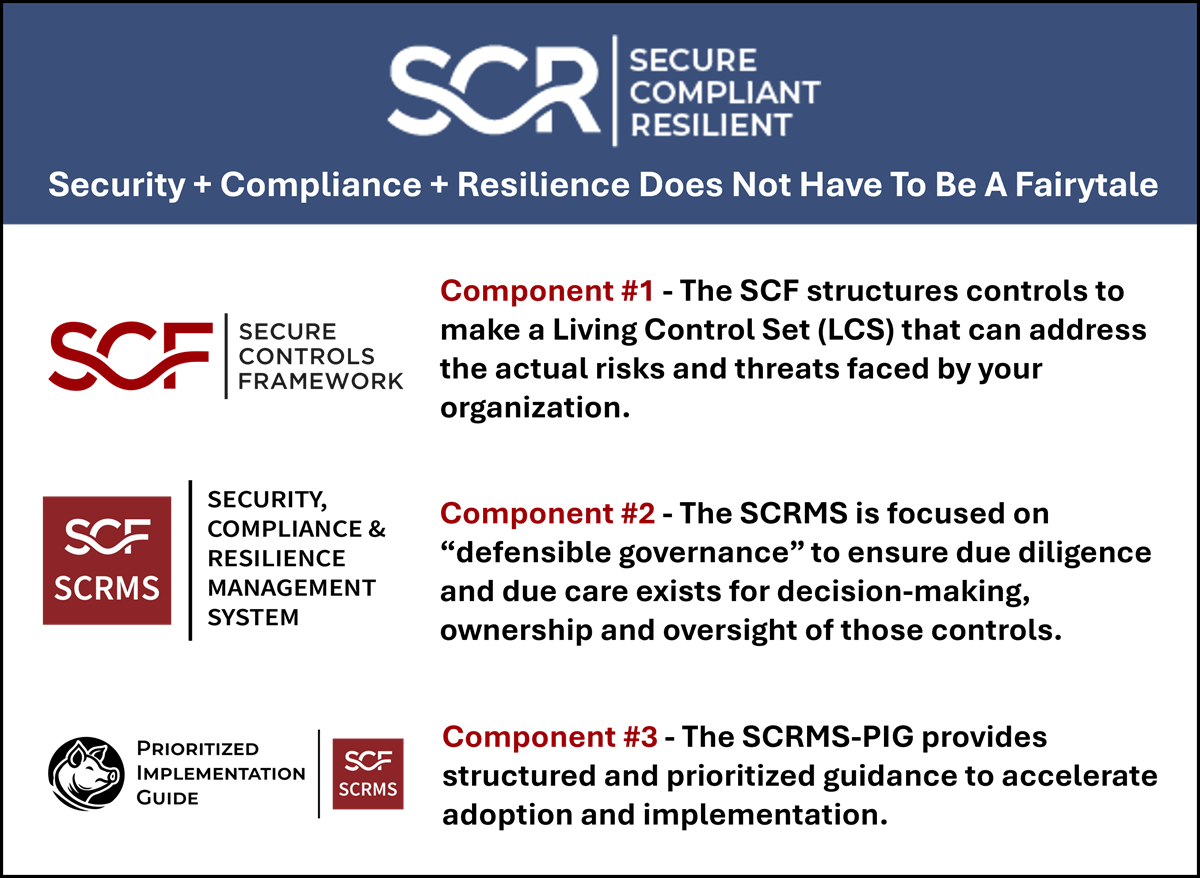
The SCF is the foundational control catalog that is a comprehensive, open-source library of cybersecurity and data privacy controls covering all 34 domains. The SCF serves as the “What?” question to define the specific controls an organization needs to implement.
Controls in the SCF are mapped to 261+ laws, regulations, and frameworks via Set Theory Relationship Mapping (STRM), enabling organizations to satisfy multiple compliance obligations through a single control implementation.
2
Secure, Compliant & Resilient Management System (SCRMS)
The SCRMS is the operational framework that defines “how” an organization builds and runs its cybersecurity program. It provides the governance model, principles, processes, and organizational accountability structures.
The SCRMS operationalizes the SCF control catalog through its nine principles and PDCA lifecycle, ensuring controls are not just selected but actually implemented, monitored, and continuously improved.
3
SCRMS-PIG: Prioritized Implementation Guide
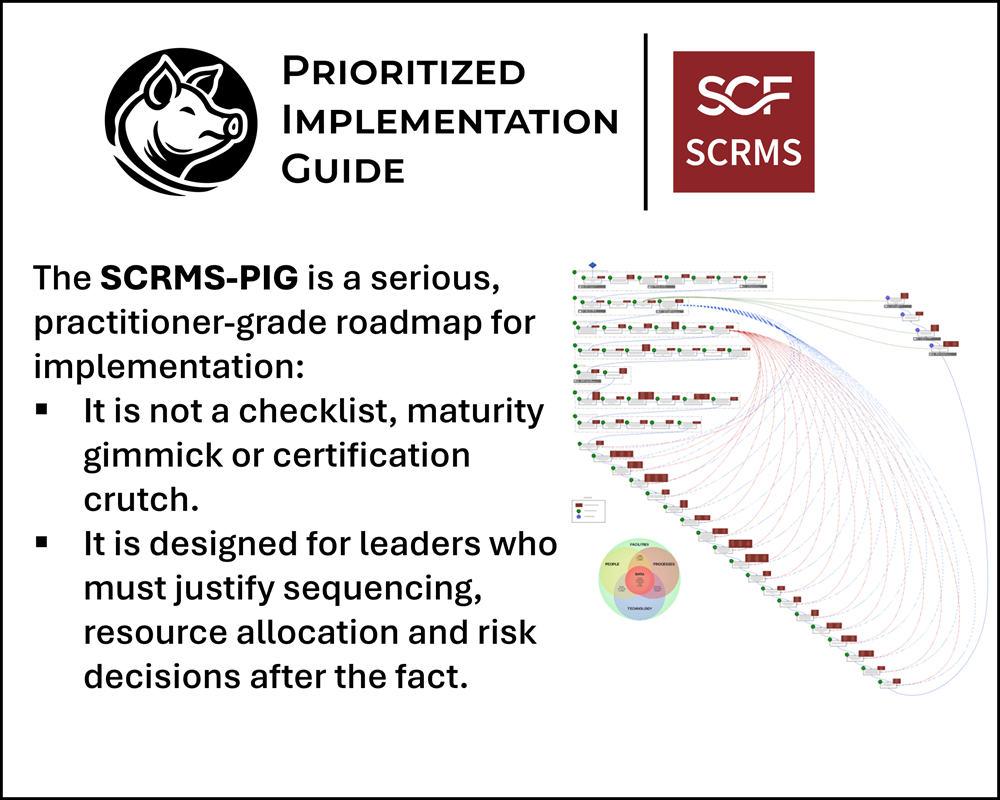
The SCRMS-PIG is a “how-to-GRC” playbook that serves as a step-by-step guide for prioritizing and sequencing SCRMS implementation based on an organization’s risk profile, maturity level, and compliance obligations.
Rather than leaving organizations to figure out where to start, the PIG provides concrete, sequenced guidance for standing up each component of the SCRMS in a logical order that generates early wins while building toward a mature program.
People, Processes, Technology, Data & Facilities
The SCRMS is explicitly designed to address cybersecurity and data privacy holistically across all five dimensions of an organization, not just technology.
Most security frameworks focus primarily on technology controls. The SCRMS recognizes that security failures often originate in people (insider threats, training gaps), processes (undefined procedures, poor change management), and facilities (physical access, environmental controls), not just technology.
People
Training, awareness, hiring, HR security, insider threat, access governance
Processes
Policies, standards, procedures, change management, incident handling
Technology
Systems, networks, endpoints, cloud, applications, tooling, configurations
Data
Classification, handling, retention, privacy, encryption, data governance
Facilities
Physical security, environmental controls, data center access, visitor management
SCRMS: Controls at the Center of Everything
The SCRMS treats controls as the central nexus of cybersecurity and data privacy operations. Unlike traditional GRC which is often process-centric, the SCRMS is controls-centric, enabling every organizational function to map to a common control language.
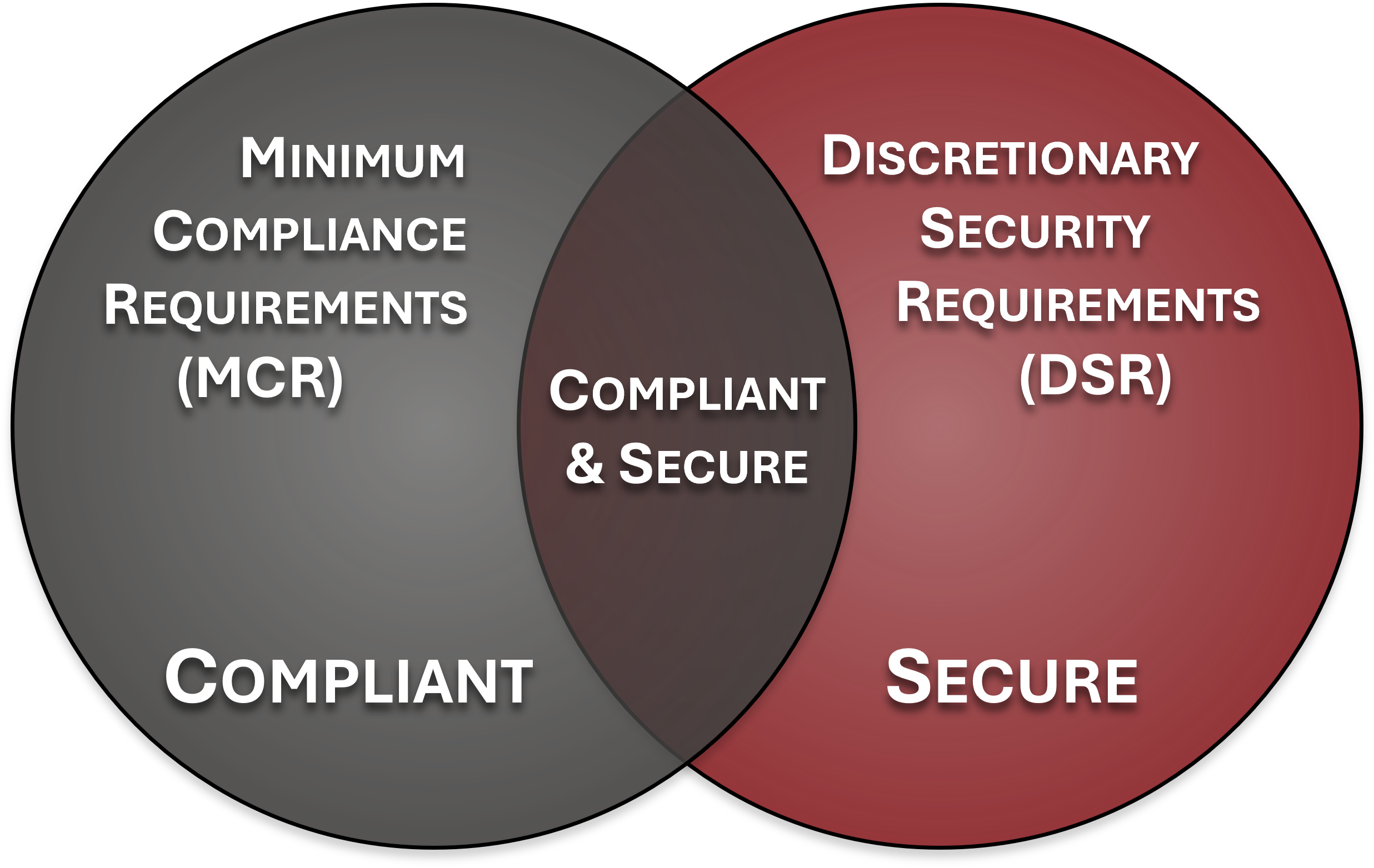
MCR: Minimum Compliance Requirements
Controls that represent the minimum bar required by external obligations such as laws, regulations, and contracts. These are non-negotiable. Not implementing them creates legal or contractual exposure.
- Externally influenced (laws, regs, contracts)
- "Must have" requirements (e.g., non-discretionary)
- Fact-finding, not risk assessment
- Forms compliance baseline
DSR: Discretionary Security Requirements
Controls selected based on the organization's own risk appetite and judgment. These go beyond the minimum and represent best-practice enhancements driven by internal risk management.
- Internally influenced (risk-based decisions)
- "Nice to have" (e.g., risk-informed choices, discretionary)
- Based on threat landscape and asset sensitivity
- Elevates posture beyond compliance floor
A PDCA Approach to Cybersecurity Governance
The SCRMS uses the Plan-Do-Check-Act (PDCA) cycle as its foundational operational model. It provides a logical way to design, build, operate, and improve a cybersecurity program over time.
Plan
Define scope, applicable laws, reg, frameworks, and risk appetite. Identify MCR and DSR. Select applicable SCF controls. Build your Minimum Security Requirements (MSR) blueprint.
Do
Implement selected controls. Publish policies, standards, and procedures. Assign stakeholder accountability. Leverage the SCRMS as a “paint by numbers” implementation guide.
Check
Assess control effectiveness via the SCR Conformity Assessment Program (SCR CAP). Measure maturity using the SCR-CMM. Monitor using built-in risk and threat catalogs.
Act
Remediate gaps from the Check phase. Update controls as laws change via the Living Control Set. Continuously improve. Prove compliance to regulators, auditors, insurers, and customers.
Nine Principles for a Sustainable Cybersecurity Program
There are nine principles associated with the SCRMS. Together they form a complete operational methodology, from initial scoping through continuous program evolution.
Establish Context
Establishing context is both a due diligence and due care element of a cybersecurity program, since context changes with time. Considerations include: mission/vision/strategy; statutory, regulatory, and contractual requirements; fiscal constraints; organizational structure; applicable geographic-specific requirements; and internal and external stakeholder expectations.
Identify Applicable Controls
A tailored set of cybersecurity and data protection controls must exist for a SCRMS implementation. This control set must be tailored to the organization’s unique requirements, combining Minimum Compliance Requirements (MCR) and Discretionary Security Requirements (DSR). This blend of “must have” and “nice to have” establishes the organization’s tailored control set.
Define Maturity Expectations
The organization must define maturity expectations for its cybersecurity and data protection controls. From the SCRMS perspective, maturity expectations define entity-specific “what right looks like” for control implementation and ongoing operation. These maturity-based criteria apply across People, Processes, Technologies, Data, and Facilities (PPTDF) and directly support the organization’s security, compliance, and resilience goals.
Publish Governance Documentation
Governance documentation is the written foundation of a cybersecurity program. This includes policies, standards, procedures, guidelines, and plans. Without published documentation, controls cannot be consistently applied, audited, or enforced. The SCF provides a direct mapping between controls and the governance documentation required to support them.
Assign Stakeholder Accountability
Every control must have an owner. Accountability structures ensure that cybersecurity responsibilities are clearly assigned to specific roles across the organization, not just the security team. This includes executives (risk ownership), managers (policy enforcement), and operational staff (procedure execution). Undefined accountability is one of the most common root causes of control failures.
Prioritize Capabilities According to Risk
Not all controls carry equal risk weight. Organizations with finite resources must prioritize implementation based on risk exposure, compliance criticality, and threat relevance. The SCRMS provides guidance for risk-based prioritization so that the most impactful controls are implemented first, ensuring early risk reduction even before a complete control set is in place.
Maintain Situational Awareness
Situational awareness is achieved through continuous monitoring, metrics collection, and periodic assessments. This principle covers logging, monitoring, alerting, and audit programs. Without situational awareness, organizations cannot detect incidents, measure control effectiveness, or demonstrate compliance. The SCRMS aligns this principle directly to the Check phase of the PDCA cycle.
Manage Risk
Risk management is the engine of the SCRMS Act phase. It encompasses: identifying and treating current deficiencies, assessing emerging threats and vulnerabilities, making risk acceptance decisions, tracking remediation, and reporting risk status to stakeholders. The SCF’s risk management controls (GOV, RSK domains) provide the specific control requirements for building a functional risk management function.
Evolve Processes
The SCRMS is a living system. Cybersecurity threats, business contexts, and regulatory landscapes all change over time. Organizations must build continuous improvement into the SCRMS lifecycle by reviewing the program periodically, updating controls and governance documentation, reassessing risk, and incorporating lessons learned from incidents and audits into the next planning cycle.
Continue Building Your SCF Program
Now that you understand how the SCRMS works, explore the core tools and resources you’ll need to implement it.
1
Download the SCF
Get the full SCF spreadsheet, including the control catalog, STRM mappings, and domain structure that powers the SCRMS.
2
SCF Domains & Principles
Explore all 34 SCF domains and understand how the Universal Control Taxonomy organizes every control.
3
Included LRF Coverage
See all 200+ laws, regulations, and frameworks mapped in the SCF, your complete compliance coverage map.
4
STRM Methodology
Understand how Set Theory Relationship Mapping (NIST IR 8477) proves SCF controls satisfy LRF requirements.
%20(white).png)