1 of 1 Items
1 of 1 Items
It is vitally important to understand that risks and threats do not exist in a vacuum. If your cybersecurity and privacy program is appropriately built, you will have a robust controls framework where risks and threats will map directly to controls. Why is this?
|
If you worry about having to preface risk management discussions with, “Please don't shoot the messenger!” then the C|P-RMM can be an additional layer of protection for your professional reputation. Where the C|P-RMM benefits security, technology and privacy personnel is the potential “get out of jail” documentation that quality risk assessments and risk management practices can provide. Just like with compliance documentation, if risk management discussions are not documented then risk management practices do not exist. Instead of executive leadership hanging blame on the CIO or CISO, quality risk management documentation can prove that reasonable steps were taken to identify, assess, report and mitigate risk. This type of documentation can provide evidence of due diligence and due care on the part of the CIO/CISO/CRO, which firmly puts the responsibility back on the management of the team/department/line of business that “owns” the risk. Based on the applicable statutory, regulatory and contractual obligations that impact the scope of a risk assessment, an organization is expected to have an applicable set of cybersecurity and privacy controls to cover those needs.
|
 |
The threat catalog use case is: What natural and man-made threats affect control execution? (e.g., if the threat materializes, will the control function as expected?)
This use case relies on the following definition of a threat:
The risk catalog use case is: What are the risks associated with a control deficiency? (e.g., if the control fails, what risk(s) is the organization exposed to?)
This use case relies on the following definition of a risk:
** Danger: state of possibly suffering harm or injury
** Harm: material / physical damage
** Loss: destruction, deprivation or inability to use
Note - Some of these risks may indicate a deficiency that could be considered a failure to meet "reasonable security practices"
| Risk Grouping | Risk # | Risk |
Description of Possible Risk Due To Control Deficiency IF THE CONTROL FAILS, RISK THAT THE ORGANIZATION IS EXPOSED TO IS: |
| Access Control | R-AC-1 | Inability to maintain individual accountability | The inability to maintain accountability (e.g., asset ownership, non-repudiation of actions or inactions, etc.). |
| R-AC-2 | Improper assignment of privileged functions | The inability to implement least privileges (e.g., Role-Based Access Control (RBAC), Privileged Account Management (PAM), etc.). | |
| R-AC-3 | Privilege escalation | The inability to restrict access to privileged functions. | |
| R-AC-4 | Unauthorized access | The inability to restrict access to only authorized individuals, groups or services. | |
| Asset Management | R-AM-1 | Lost, damaged or stolen asset(s) | Lost, damaged or stolen assets. |
| R-AM-2 | Loss of integrity through unauthorized changes | Unauthorized changes that corrupt the integrity of the system / application / service. | |
| R-AM-3 | Emergent properties and/or unintended consequences | Emergent properties and/or unintended consequences from Artificial Intelligence & Autonomous Technologies (AAT). | |
| Business Continuity | R-BC-1 | Business interruption | Increased latency, or a service outage, that negatively impact business operations. |
| R-BC-2 | Data loss / corruption | The inability to maintain the confidentiality of the data (compromise) or prevent data corruption (loss). | |
| R-BC-3 | Reduction in productivity | Diminished user productivity. | |
| R-BC-4 | Information loss / corruption or system compromise due to technical attack | A technical attack that compromises data, systems, applications or services (e.g., malware, phishing, hacking, etc.). | |
| R-BC-5 | Information loss / corruption or system compromise due to non-technical attack | A non-technical attack that compromises data, systems, applications or services (e.g., social engineering, sabotage, etc.). | |
| Exposure | R-EX-1 | Loss of revenue | A negatively impact on the ability to generate revenue (e.g., a loss of clients or an inability to generate future revenue). |
| R-EX-2 | Cancelled contract | A cancelled contract with a client or other entity for cause (e.g., failure to fulfill obligations for secure practices). | |
| R-EX-3 | Diminished competitive advantage | Diminished competitive advantage (e.g., lose market share, internal dysfunction, etc.). | |
| R-EX-4 | Diminished reputation | Diminished brand value (e.g., tarnished reputation). | |
| R-EX-5 | Fines and judgements | Financial damages due to fines and/or judgements from statutory / regulatory / contractual non-compliance. | |
| R-EX-6 | Unmitigated vulnerabilities | Unmitigated technical vulnerabilities that lack compensating controls or other mitigation actions. | |
| R-EX-7 | System compromise | A compromise of a system, application or service that affects confidentiality, integrity, availability and/or safety. | |
| Governance | R-GV-1 | Inability to support business processes | Insufficient cybersecurity and/or privacy practices that cannot securely support the organization's technologies & processes. |
| R-GV-2 | Incorrect controls scoping | Missing or incorrect cybersecurity and/or privacy controls due to incorrect or inadequate control scoping practices. | |
| R-GV-3 | Lack of roles & responsibilities | Insufficient cybersecurity and/or privacy roles & responsibilities that cannot securely support the organization's technologies & processes. | |
| R-GV-4 | Inadequate internal practices | Insufficient cybersecurity and/or privacy practices that can securely support the organization's technologies & processes. | |
| R-GV-5 | Inadequate third-party practices | Insufficient Cybersecurity Supply Chain Risk Management (C-SCRM) practices that cannot securely support the organization's technologies & processes. | |
| R-GV-6 | Lack of oversight of internal controls | The inability to demonstrate appropriate evidence of due diligence and due care in overseeing the organization's internal cybersecurity and/or privacy controls. | |
| R-GV-7 | Lack of oversight of third-party controls | The inability to demonstrate appropriate evidence of due diligence and due care in overseeing third-party cybersecurity and/or privacy controls. | |
| R-GV-8 | Illegal content or abusive action | Disruptive content or actions that negatively affect business operations (e.g., abusive content, harmful speech, threats of violence, illegal content, etc.). | |
| Incident Response | R-IR-1 | Inability to investigate / prosecute incidents | Insufficient incident response practices that prevent the organization from investigating and/or prosecuting incidents (e.g., chain of custody corruption, available sources of evidence, etc.). |
| R-IR-2 | Improper response to incidents | The inability to appropriately respond to incidents in a timely manner. | |
| R-IR-3 | Ineffective remediation actions | The inability to ensure incident response actions were correct and/or effective. | |
| R-IR-4 | Expense associated with managing a loss event | Financial repercussions from responding to an incident or loss. | |
| Situational Awareness | R-SA-1 | Inability to maintain situational awareness | The inability to detect cybersecurity and/or privacy incidents (e.g., a lack of situational awareness). |
| R-SA-2 | Lack of a security-minded workforce | The inability to appropriately educate and train personnel to foster a security-minded workforce. | |
| Supply Chain | R-SC-1 | Third-party cybersecurity exposure | Loss of Confidentiality, Integrity, Availability and/or Safety (CIAS) from third-party cybersecurity practices, vulnerabilities and/or incidents that affects the supply chain through impacted products and/or services. |
| R-SC-2 | Third-party physical security exposure | Loss of Confidentiality, Integrity, Availability and/or Safety (CIAS) from physical security exposure of third-party structures, facilities and/or other physical assets that affects the supply chain through impacted products and/or services. | |
| R-SC-3 | Third-party supply chain relationships, visibility and controls | Loss of Confidentiality, Integrity, Availability and/or Safety (CIAS) from "downstream" third-party relationships, visibility and controls that affect the supply chain through impacted products and/or services. | |
| R-SC-4 | Third-party compliance / legal exposure | The inability to maintain compliance due to third-party non-compliance, criminal acts, or other relevant legal action(s). | |
| R-SC-5 | Use of product / service | The misuse of the product / service in a manner that it was not designed or how it was approved for use. | |
| R-SC-6 | Reliance on the third-party | The inability to continue business operations, due to the reliance on the third-party product and/or service. |
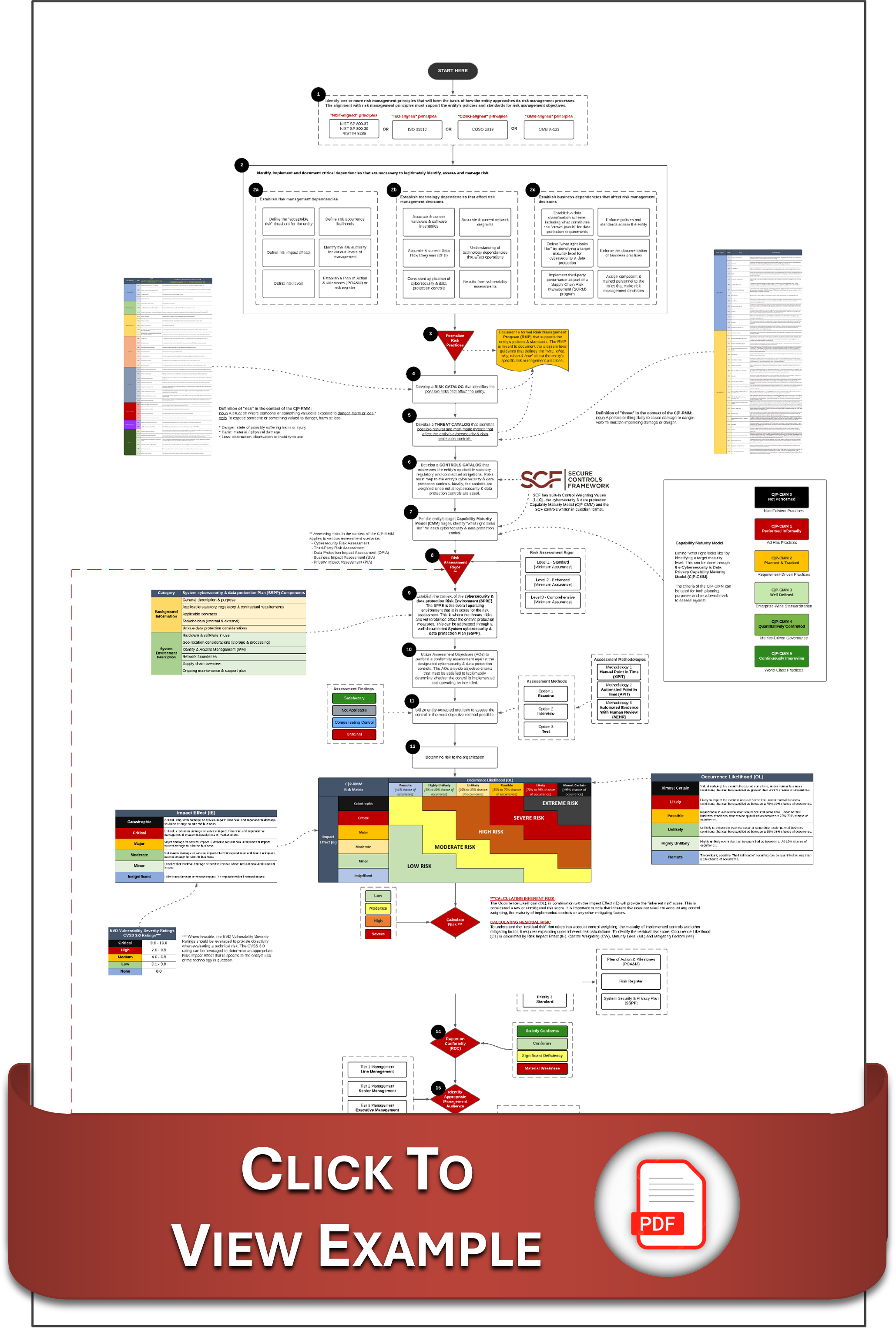
The C|P-RMM breaks risk management down to seventeen (17) steps. Please download the guide for the overview and you can click on the image below for a PDF version of the C|P-RMM infographic. The C|P-RMM breaks risk management down to 16 steps. Please download the guide for the overview and you can click on the image below for a PDF version of the C|P-RMM infographic. The C|P-RMM provides a clear method to calculate both inherent and residual risk. Please download the guide for the overview and you can click on the image below for a PDF version of the C|P-RMM infographic.